
Retail: The Execution Layer Applied
Retail wins by closing the loop fastest. AI removes the humans from that loop — and opens commercial capabilities that didn't exist before.

Retail CEOs are carrying two distinct sets of concerns right now, and most AI conversations only address one of them. The first is operational: margins compressing for a decade, store labor that is simultaneously the largest cost and the primary service differentiator, inventory decisions made months in advance for a customer whose preferences shift in weeks. These are execution problems. They have always been execution problems. What changes is that the operational layer - a thousand decisions a day across stores, supply chains, and digital channels - is now something AI can run faster, cheaper, and more continuously than any human organization can.
The second set of concerns is less discussed but more consequential for valuation: the customer relationship. AI doesn’t just automate what retailers already do. It enables a precision and personalization of customer engagement that was previously impossible at scale. The Concierge Agent that identifies a high-value customer who hasn’t visited in six weeks, knows their purchase history and size preferences, and initiates a relevant, timely conversation that drives a store visit - that is not a cost reduction. It is a new revenue motion. The retailer who deploys it has a commercial capability their competitors don’t.
The same logic extends to product creation and sourcing. AI-assisted trend analysis that synthesizes consumer signals, social data, and competitive positioning in real time changes what the buying team can see before they commit. AI-generated product content that adapts to individual customer context changes the conversion surface. These are not efficiency improvements layered onto existing processes. They are structural expansions of what a retail business can do commercially.
The disruption in retail is not coming from a new kind of company. It is coming from the widening gap between retailers rebuilding their execution layer and commercial capabilities around AI - and those managing it as an efficiency initiative. That gap is already measurable. In three years it will be structural.
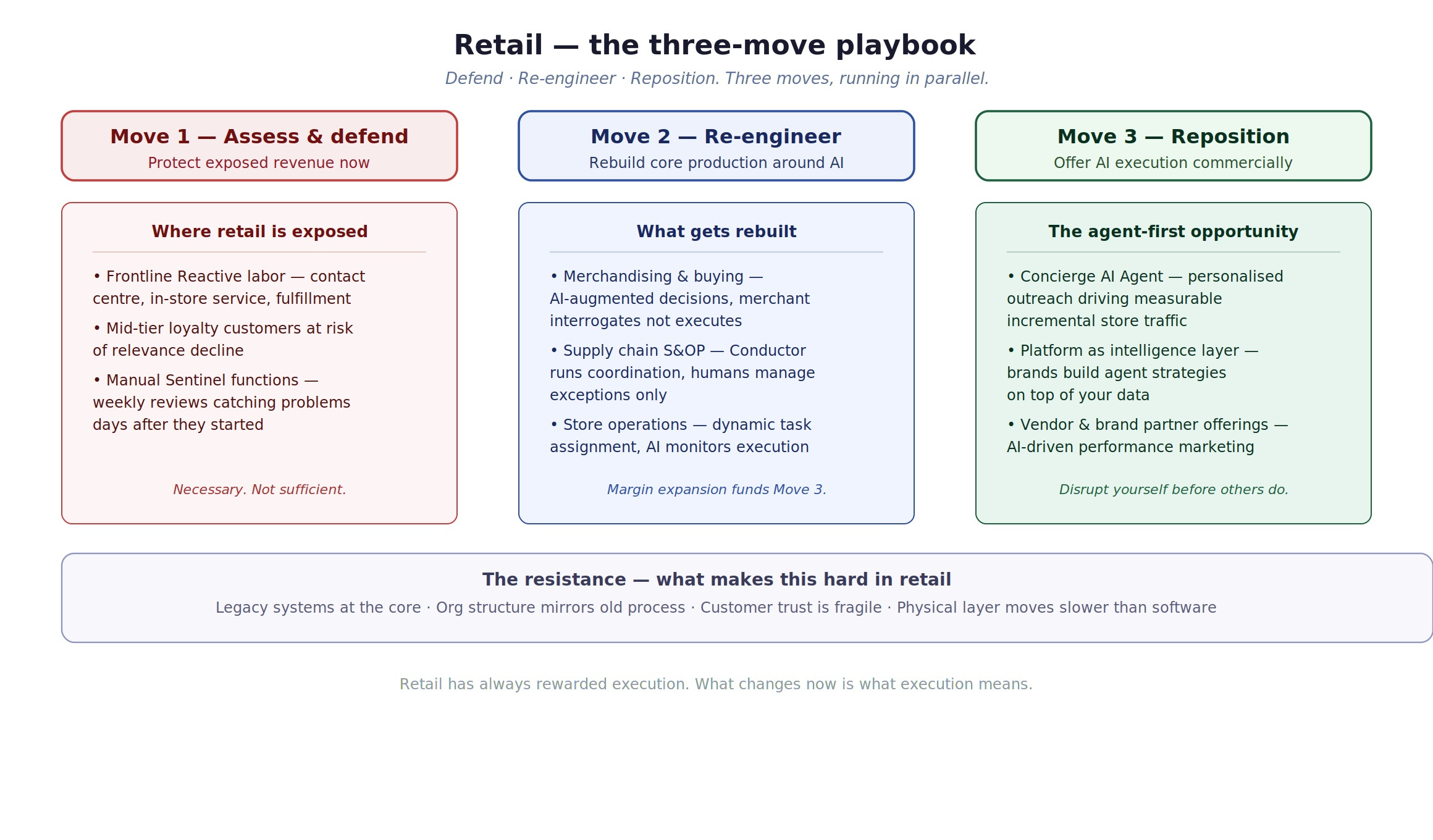
A quick reminder of the playbook: map your business to the eight patterns, then three moves - assess and defend your exposed revenue, re-engineer your core production around AI execution, and reposition as agent-first. This piece applies all three to retail.
The pattern map - how retail actually works
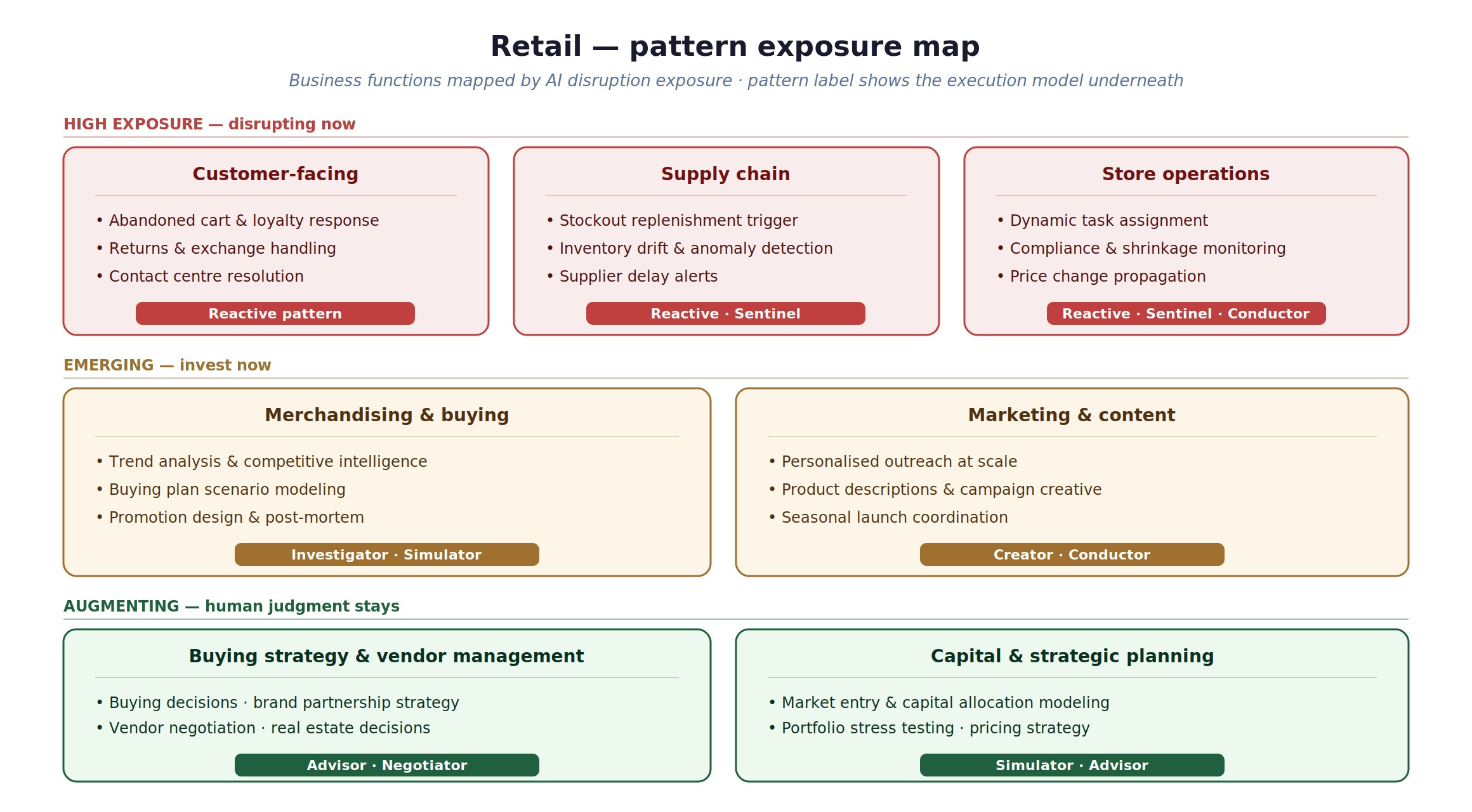
Retail runs on more patterns simultaneously than almost any other industry. The diagnostic question is not which patterns retail uses - it uses most of them - but where the exposure sits and on what timeline.
High exposure - disrupting now
Three business functions are running on patterns that AI is already executing at scale elsewhere, and where the disruption timeline is shortest.
Customer-facing operations - abandoned cart recovery, loyalty threshold responses, returns and exchange handling, contact centre resolution - are Reactive loops. An event arrives and a response is required. Today those responses involve humans at multiple points. AI closes the loop faster, cheaper, and without the labor overhead. The retailers who have moved here are already compounding the advantage.
Supply chain - stockout replenishment triggers, inventory drift detection, supplier delay alerts - combines the Reactive and Sentinel patterns. Something happens and the system responds; simultaneously, something is drifting toward a problem and needs to be caught before it becomes a crisis. Most retailers catch these signals in weekly reviews. A Sentinel agent catches them in real time, before the cost compounds.
Store operations - dynamic task assignment, compliance and shrinkage monitoring, price change propagation - runs on Reactive, Sentinel, and Conductor patterns simultaneously. Tasks need to be assigned based on real-time conditions. Anomalies need to be caught continuously. Workstreams across a store opening or promotional event need to be coordinated. The store manager running all of this manually is the most expensive coordinator in retail.
Emerging - invest now
Two functions are earlier in the disruption curve but moving fast, and where the investment made now compounds.
Merchandising and buying runs on the Investigator and Simulator patterns. Trend analysis, competitive intelligence, buying plan scenario modeling, promotion design and post-mortem - these are research and modeling loops that today require teams of analysts and weeks of work. AI compresses them to hours and expands the scenario space from five to five hundred. The merchant’s role shifts from executing the analysis to interrogating it.
Marketing and content runs on the Creator and Conductor patterns. Personalised outreach at scale, product descriptions, campaign creative, seasonal launch coordination - the marginal cost of producing this content is collapsing toward zero. The retailer still running a content team manually producing copy for ten thousand SKUs is carrying cost that is already obsolete.
Augmenting - human judgment stays
Two functions remain firmly in the human domain - not because AI can’t assist, but because the decisions carry accountability that requires a human to own them.
Buying strategy and vendor management - buying decisions, brand partnership strategy, vendor negotiations, real estate portfolio decisions - runs on the Advisor and Negotiator patterns. The analysis is AI-augmented. The decision and the relationship are human.
Capital and strategic planning - market entry modeling, portfolio stress testing, pricing strategy - runs on the Simulator and Advisor patterns. AI models a thousand scenarios. The executive committing capital is still the human applying judgment to what the model produces.
Most large retailers, in my experience, are still in the early stages of this transition - and moving more slowly than the opportunity warrants. Customer-facing automation is the most attacked area, with LLM-based agents now handling support interactions in ways that genuinely feel different from the rule-based chatbots that came before. The supply chain instrumentation is a different story - most of what is running there still relies on traditional automation and pre-LLM approaches. The event-driven replenishment triggers, the inventory monitoring, the demand signals - that work has been underway for years and largely hasn’t made the leap to LLM-based execution yet. The genuinely new capability is only beginning to land.
Store operations is the area that has changed least. Two observations from the fashion, footwear, and apparel segment - which is where my direct exposure sits, with the caveat that the big box operators are considerably further along. The first is a fashion retailer with a strong customer-centricity culture, where the store associate is the product. These are experienced sellers who operate their section of the store like a small business - they know their customers, they drive repeat visits, they own the relationship. This retailer has moved beyond traditional BI and analytics in meaningful ways, deploying AI tools that give those associates better signal about who to reach out to and when. The model is not replacing the associate. It is making the associate more effective at the thing they were already exceptional at. The second observation is associate training - an area where AI adoption has been notably high. Consider a mixed cart return: a customer arrives at the register with items from multiple transactions, some eligible for return, some not, some subject to different policies. It gets complicated fast. The traditional response is a supervisor call - a delay, a queue, a frustrated customer. An AI agent invoked in that moment can either guide the associate through the resolution or, in more advanced deployments, facilitate the transaction directly. Most retailers are at the former stage. The latter is where this is heading.
Move 1 - Assess and defend
Two exposures demand immediate attention.
The first is labor. The Reactive pattern accounts for the majority of frontline retail labor - contact centre agents, fulfillment teams, store associates responding to operational exceptions. AI is already executing these loops in production at retailers who have moved. The organizations that haven’t are carrying a cost structure that is structurally exposed on a two to three year timeline. The defense posture here is a clear map of which labor-dependent Reactive loops are most at risk and a timeline for rebuilding them before a competitor’s cost advantage becomes visible to customers.
The second is the customer relationship. Loyalty runs on relevance, and relevance is eroding faster than most retailers recognize. The medium-tier loyalty customer - not engaged enough to be sticky, not disengaged enough to have already left - is the segment most at risk. Not from a competitor’s better product, but from a competitor’s better signal detection. The defense here is identifying that segment precisely and getting ahead of the relevance decline before it becomes churn.
Move 2 - Re-engineer the core
The production processes in retail most ripe for re-engineering are not the ones that look most like automation. They are the ones where human execution of a pattern has been the constraint on speed, quality, and commercial reach.
Merchandising and buying. The buying decision today is made by humans working from historical data, market intuition, and vendor relationships. The Investigator and Simulator patterns applied here produce something qualitatively different: a buying recommendation built on real-time demand signals, competitor pricing, trend data, customer behavioral patterns, and scenario modeling across hundreds of variables simultaneously. The merchant’s role shifts from building the analysis to challenging it - applying the judgment that comes from knowing a category, a customer, and a vendor relationship in ways the model doesn’t. Better decisions, made faster, with fewer expensive mistakes at the margin.
Supply chain planning. The weekly S&OP process - demand planning, inventory positioning, replenishment decisions - is a Conductor pattern running on a large team of planners, analysts, and coordinators. The re-engineered version runs the coordination layer autonomously, surfaces the decisions that require human judgment, and executes routine replenishment without human involvement. The planning team stops aggregating spreadsheets and starts managing exceptions and edge cases.
Content and marketing production. The content surface in retail is enormous - product descriptions, promotional copy, personalised outreach, visual merchandising guidance, campaign creative across dozens of channels. Today this requires significant headcount and produces inconsistent output at high cost. The Creator pattern running on AI produces this content at scale, adapted to individual customer context and channel requirements, at a fraction of the current cost. The marketing team shifts from producing content to defining the brief and curating the output.
Move 3 - Reposition as agent-first
This is the move that separates the retailers who survive the transition from the ones who lead it.
The Concierge Agent. A retailer that deploys a personalised AI agent - one that knows a specific customer’s purchase history, preferences, loyalty status, and local store inventory - and uses it to initiate a relevant, timely conversation with that customer is not automating outreach. It is offering something that did not exist before: a shopping relationship that feels personal, responds in real time, and drives conversion without requiring a human associate to initiate every interaction. The commercial model for this is not an internal efficiency story. The retailer that can demonstrate measurable sales lift from Concierge Agent interactions is offering their brand partners and wholesale vendors a capability they will pay for. The agent becomes a revenue line, not just an operational tool.
Precision sourcing and product creation. AI-assisted trend synthesis changes the buying team’s view before they commit capital. The retailer whose buyers are working from a real-time synthesis of consumer signals, social data, and competitive positioning is making fundamentally better sourcing decisions than the one whose buyers are working from last season’s sell-through and a trade show visit. At scale, this is a margin story: fewer wrong bets, faster response to emerging signals, less inventory trapped in categories that already peaked.
The platform play. The most ambitious version of the agent-first repositioning is owning the intelligence layer. A retail technology platform that exposes operational data - inventory, customer, transaction, supply chain - through an AI-accessible layer becomes the foundation that brands and operators build their agent strategies on top of. The platform stops being a system of record and becomes a system of intelligence. Customers and brand partners build on it rather than around it.
My early conversations with retail CIOs about the Concierge Agent have been genuinely encouraging - and revealing about where the real pain sits. Store traffic is a critical metric in the fashion, footwear, and apparel segment. Every CIO I have spoken with knows this and is actively trying to move it. What they also know is that their existing CRM tools have been attempting the same thing for years - and consistently falling short. The problem is precision. The message goes out to a broad segment. The product-to-customer match is approximate. The conversion to actual foot traffic is a small fraction of what the model predicted. The signal-to-noise ratio is poor enough that customers start ignoring the communications entirely.
The Concierge approach is landing differently in these conversations. The specificity of matching a known customer to a relevant product, an in-store event, or a moment when their size is actually in stock at their nearest location - that is the precision the CRM model never had. The response has been less “interesting technology” and more “this solves a problem we have been trying to solve for a long time.”
What has been equally notable is the shift in the conversation itself. For most of my interactions with retail technology leadership, the framing is maintain and don’t break - keep the systems running, minimize disruption, manage the upgrade cycle. The Concierge Agent conversation is a revenue conversation. It is about driving traffic, increasing basket size, improving loyalty tier progression. That shift in framing - from cost center to revenue contributor - changes the energy in the room. It has changed ours too.
The resistance - what makes this hard in retail
Four structural realities slow the transformation in retail more than in most industries.
Legacy systems at the core. Most large retailers run on transaction processing infrastructure designed before real-time data architecture existed. The Reactive and Sentinel patterns require clean, fast event streams from the operational layer. Getting those streams out of a legacy POS and OMS is an integration problem that takes time and engineering investment to solve before any of the AI applications on top of it can work properly.
Organizational structure mirrors the old process. Retail organizations are structured around the functions that the old production process required - buying teams, planning teams, marketing teams, store operations teams. The re-engineered production process cuts across those structures. The merchant who owned the buying decision end to end is now one input into an AI-augmented recommendation. That is a political problem as much as a technical one.
Customer trust is fragile. Retail customers have a low tolerance for AI interactions that feel impersonal, irrelevant, or manipulative. The Concierge Agent that sends the right message at the right moment builds trust. The one that sends the wrong message at the wrong moment - or that feels like surveillance rather than service - destroys it faster than any human misstep would. The bar for behavioral model quality is high, and the cost of getting it wrong is a customer relationship, not a support ticket.
The physical layer moves at a different clock. Retail is not a pure digital business. Inventory is physical. Stores are physical. Supply chains involve physical goods moving through physical infrastructure. The AI can optimize the decision layer in real time. The physical layer responds on a different timeline. The gap between what the model says and what the supply chain can execute is where most retail AI initiatives underdeliver against their promise.
The economic consequence
The retail industry has historically rewarded scale. The largest retailers could afford the best systems, the most sophisticated planning teams, the deepest vendor relationships. AI is changing that equation in a way that most large retailers haven’t fully reckoned with.
The cost of deploying serious AI capability - Reactive loop automation, Sentinel monitoring, Concierge Agent outreach, AI-assisted trend analysis - is a fraction of what equivalent capability required even five years ago. A mid-size regional retailer can now instrument its supply chain, personalize customer outreach, and model buying scenarios with tools and economics that were previously available only to the largest operators. The investment required to be genuinely competitive on the execution and customer engagement dimensions is no longer a function of scale.
This is the level-playing-field consequence of AI in retail. The large incumbent whose advantage was operational sophistication and data depth will find that the moat is narrower than it looks. The smaller, nimbler retailer who moves decisively on the three-move playbook - defends its loyalty base, rebuilds its core processes, deploys a Concierge Agent - can close the gap on customer relevance and operational efficiency faster than any previous technology cycle allowed.
The bifurcation that matters is no longer large versus small. It is fast versus slow. The retailers who move - regardless of size - will define the next decade of the industry. The ones who wait, regardless of how large they are, will find the window closing faster than their planning cycles anticipated.
Retail has always rewarded execution. What changes now is that execution capability is no longer the exclusive property of the companies that could afford to build it.
Next: IT Services - the industry built on labor arbitrage, billed by the hour, and credentialed by years of experience. All three foundations are breaking simultaneously.