
The Execution Layer: What You Do With All of This
The patterns are mapped. The disruption is underway. Here is the playbook — three moves, running in parallel, that work across every industry.

I started mapping these patterns while building Flinch - a general-purpose agentic platform - and realized I had only addressed one of eight fundamental shapes of how work gets done. That realization sent me back to first principles: not what AI can do, but what work actually is. What it has always been. Before software, before corporations, before the industrial organization of labor into firms and functions and job titles.
What I found is that work has always followed eight patterns. Not nine. Not twelve. Eight. And they haven’t changed in decades, maybe centuries. The Reactive loop that a claims adjuster runs today is architecturally identical to the one a medieval toll collector ran. The Investigator loop that a market researcher runs is the same loop a Renaissance natural philosopher ran. The Conductor pattern that a program manager runs is the same pattern a military logistics officer ran. The patterns are ancient. What changes is who - or what - executes them.
This series has gone deep on each pattern. What I want to do in this final piece is step back and answer the questions the series has been building toward. Not “what is happening” - that case has been made across eight pieces. But “what do you actually do with this?” The practitioner question. The one that matters when you put down the reading and go back to your organization.
The disruption is not uniform - and the sequence matters
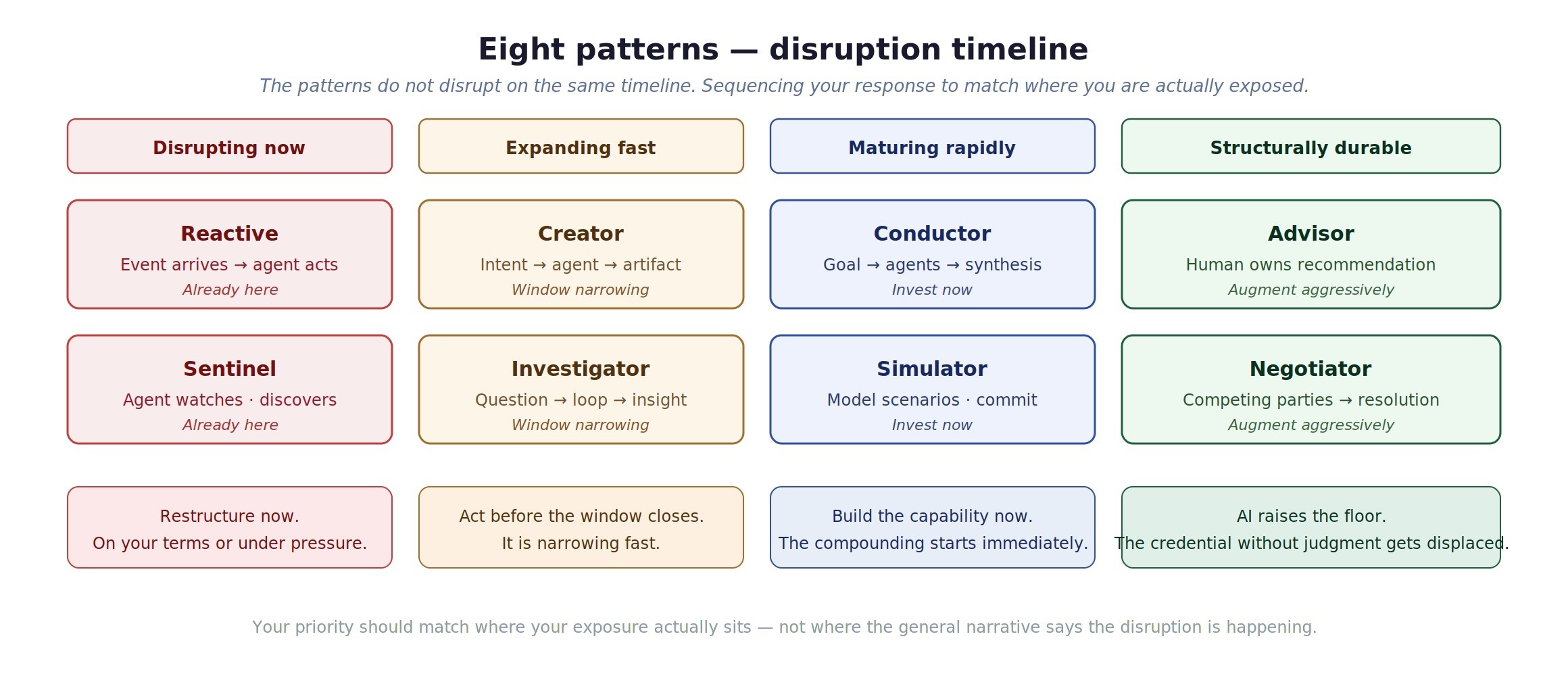
The first thing to understand about acting on this framework is that the eight patterns do not disrupt on the same timeline. Some are already being executed by AI at scale. Others are years away from full displacement. Getting the sequence wrong - investing in defending patterns that are already gone, or ignoring patterns that are actively being attacked - is the most common and costly mistake organizations make.
Here is the honest sequence, as best as I can read it.
Already executing autonomously at scale: Reactive and Sentinel. The infrastructure exists, the economics are proven, and the early movers are already compounding. If your business runs primarily on these patterns - high-volume event-driven workflows, continuous monitoring and detection - the disruption is not coming. It is here. The question is whether you are restructuring on your own terms or waiting to restructure under pressure.
At KORE, where I was CTO, we managed connectivity for IoT devices at scale - machines that couldn’t go dark. When a device stopped responding, a Level 2 operator took the call, ran a defined sequence, issued a SIM reset, and filed a precise ticket describing the customer’s business and the exact failure. The work was real. The pattern was fixed. The human executing it was, in retrospect, optional. That loop is running on AI agents today. The question is whether it is running on yours.
Executing well in bounded contexts, expanding fast: Creator and Investigator. AI-generated artifacts and AI-driven research loops are production-grade in most professional domains. The productivity multipliers are real and documented. The displacement of roles that primarily executed these patterns is already visible in hiring data across software engineering, marketing, consulting, and legal research. The window for organizations to restructure around these patterns on their own terms is narrow.
Emerging capability, rapid maturation: Conductor and Simulator. The architecture is proven, production implementations exist, and the economic case is clear. But the deployment curve is earlier - most organizations are in early adoption rather than full displacement. The organizations that invest in Conductor and Simulator capability now are building a compounding advantage. The ones that wait are watching that advantage accumulate on the other side.
Structurally durable, augmenting fast: Advisor and Negotiator. The human stays in the loop by design - not because AI can’t execute, but because the pattern requires human accountability, relationship trust, and the judgment that comes from having skin in the game. AI is raising the quality ceiling of what advisors and negotiators can deliver. The displacement here is not of the human but of the layer that was doing synthesis and research without adding genuine judgment. The credential without the judgment is what gets displaced.
The strategic implication: your sequencing priority should match where your organization’s exposure actually sits - not where the general AI narrative says the disruption is happening. A professional services firm primarily running Investigator and Creator patterns faces a different and more immediate challenge than a financial services firm running Sentinel and Advisor patterns. The framework’s value is in making that specificity legible.
The services disruption is not a prediction - it is happening now
I have made one claim throughout this series more consistently than any other, and I want to restate it plainly in the close: services businesses will be disrupted faster and more completely than SaaS companies. Not eventually. Now.
The reason is structural and it does not require prediction. SaaS companies systematized patterns into software. They have switching costs, deep integrations, long-term contracts, and compounding product moats. AI disrupts them - but it disrupts them incrementally, as a better version of what they built, constrained by the same customer relationships and switching cost economics they built their defensibility on.
Services businesses have none of that. Their product is human execution of a pattern. A consulting firm’s product is humans executing the Investigator and Creator patterns. A law firm’s product is humans executing the Investigator, Advisor, and Negotiator patterns. An IT services company’s product is humans executing the Reactive and Conductor patterns. When AI can execute the same patterns at a fraction of the cost, there is no switching cost protecting the incumbent. The billing model doesn’t evolve. It collapses.
This is already visible in the economics of every major professional services category. The productivity multipliers are not theoretical. The headcount math is being done inside every major firm right now, reframed as efficiency improvement and digital transformation. What it actually is: the systematic removal of human execution from patterns that AI now runs better, faster, and cheaper. The firms that acknowledge this clearly and restructure around it will survive. The firms that manage it as a cost optimization exercise will not recognize the existential nature of what is happening until it is too late.
The bifurcation inside every role
Across eight patterns and dozens of professional roles, one structural consequence appears again and again. The bifurcation.
Every role being disrupted by AI splits into two fundamentally different kinds of work. The thinking work - judgment, risk assessment, relationship management, the questions nobody asked yet - survives and often expands with AI augmentation. The grunt work - production, aggregation, synthesis, routing, formatting - moves to AI execution.
Early in my consulting career, I was on an engagement in Australia where the client wanted more visibility into our approach. Consultants were pulled off delivery to write an approach document. Then a document explaining how to navigate the approach document. Then a summary for stakeholders who didn’t have time for the full version. A colleague named Freddi looked up from his screen and delivered the most precise diagnosis of consulting waste I have ever heard: “I don’t have time to review your approach document, or the summary to the approach, or the approach to the summary.” Four consultants, billing by the hour, producing documents about documents. The intent existed. The judgment existed. The production cost was the entire problem. That is the Creator pattern’s grunt work in its purest form - and it is exactly what AI now eliminates.
This is not a comfortable message for the people whose careers have been built primarily on grunt work. But the bifurcation is not a future scenario. It is visible right now in the PM who still spends most of their week on status reports. In the associate who still spends most of their week building models. In the analyst who still spends most of their week assembling decks. In the advisor who still spends most of their week on research synthesis.
The people in those roles have a choice that is narrowing. They can move toward the thinking work - develop the judgment, the client relationships, the organizational credibility that AI cannot replicate - and find that AI gives them leverage they never had before. Or they can continue executing the grunt work and find that AI does it better, faster, and without the overhead.
The organizations that create the conditions for that transition - that invest in developing judgment capacity rather than just deploying productivity tools - will build a fundamentally more capable workforce. The ones that simply deploy AI to compress headcount will save money in the short term and hollow out their institutional knowledge in the medium term.
The Playbook: What You Do After You’ve Mapped
I get asked this question more than any other. You’ve read the patterns. You’ve mapped your business - your revenue lines, your functions, your products - against the eight. You can see where the exposure is and roughly on what timeline. Now what?
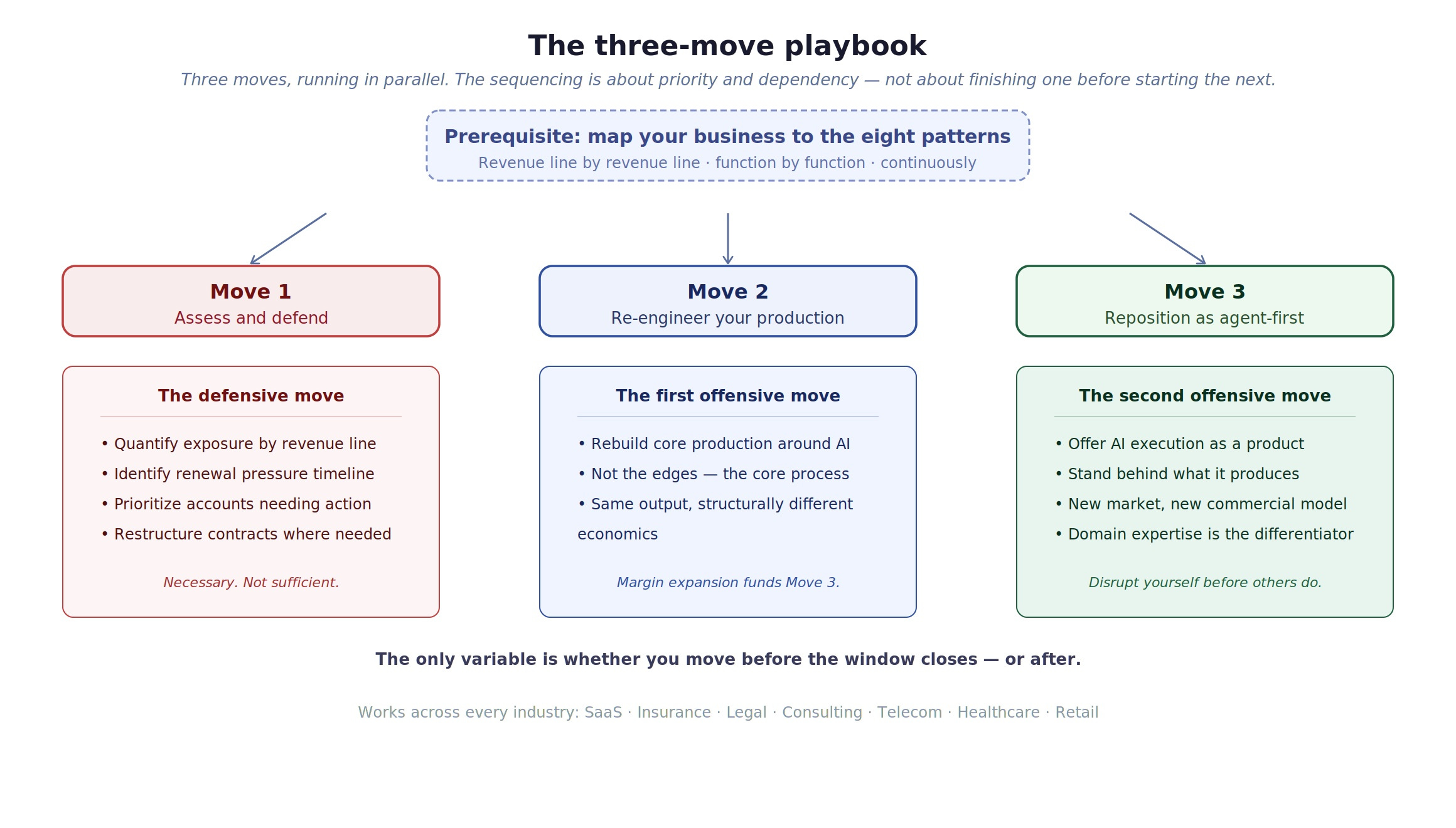
Three moves. They run in parallel once you’re clear on the map. The sequencing is about priority and dependency, not about finishing one before starting the next.
Move 1 - Assess and defend.
The map tells you where the exposure is. The first move is to quantify it precisely and protect what matters most. Not at the category level - at the revenue line level. Which customers, which products, which service lines are most exposed, on what timeline, with what renewal or retention pressure in the next twelve to eighteen months.
The output of this move is a defense posture: which relationships get immediate attention, which contracts need restructuring, which product lines need acceleration to stay competitive. This is not a strategy exercise. It is a working list with owners and deadlines.
The mistake most organizations make here is treating this as the whole response. Defending what you have buys time. It does not change the trajectory. A law firm that extends client relationships without changing how it delivers legal work is deferring the problem, not solving it. Defense is necessary. It is not sufficient.
Move 2 - Re-engineer your production.
This is the first offensive move - and it is structurally different from defense. You are not protecting existing revenue. You are rebuilding how the work gets done.
Every business running on the eight patterns has a production process - the way the work actually flows from input to output. A software company has an engineering process. An insurance carrier has a claims process. A law firm has a research, drafting, and review process. A consulting firm has an analysis and delivery process. In every case, that production process was designed around human execution of the patterns. AI changes what that process can look like - dramatically.
The re-engineering move is to take your core production process and rebuild it around AI execution of the pattern layer. Not automate the edges. Rebuild the core. The insurance carrier that rebuilds claims processing around AI execution - with humans reviewing only what genuinely requires judgment - is not doing the same work more efficiently. It is running a structurally different operation with structurally different economics. The law firm that rebuilds legal research and drafting around AI execution is not just faster. It is operating at a cost basis that changes what it can profitably offer and to whom.
This is where the margin expansion comes from. And that margin funds the third move.
Move 3 - Reposition as agent-first.
This is the move most organizations haven’t thought through yet. And it is the one that separates the firms that define the next decade from the ones that survive it.
You have mapped your patterns. You have defended your revenue. You have rebuilt your production around AI execution. Now the question is: can you offer that AI execution as a product - and stand behind what it produces?
The law firm that offers an NDA agent, prices it on outcomes, and puts its professional reputation behind the output is not automating a workflow. It is creating a new commercial model. One that opens a market that didn’t exist before - clients who couldn’t afford bespoke legal work at bespoke rates but will pay for AI-delivered work with professional accountability attached. The insurer that offers an underwriting agent to brokers. The consulting firm that offers AI-executed market analysis as a product. The SaaS company that exposes its platform as the layer enterprise customers build their own AI agents on top of.
In each case the move is the same: take the pattern execution you have rebuilt internally and offer it externally as a commercial capability. With skin in the game. That last part is what makes it defensible - the professional accountability, the domain expertise behind the agent, the willingness to stand behind what it produces. That is not something a generic AI platform can replicate. It is the thing that only you, with your domain depth and your client relationships, can credibly offer.
This is disrupting yourself before someone else does it for you. The firms that move here first will define their categories. The ones that wait will find themselves competing against the ones that didn’t.
Three moves. One sequence.
Defend what you have while you still have the relationships and the runway to act. Re-engineer your production before the margin compression forces you to do it under pressure. Reposition as agent-first before a competitor or a new entrant does it first and takes the market you could have owned.
The map tells you where you are. The playbook tells you what to do next. The only variable is whether you move before the window closes or after.
What comes next in this series
The eight patterns are the framework. The playbook is the action model. What comes next is applying both to specific industries - not at the category level, but at the level of real business processes, real revenue lines, and real decisions that leaders in those industries are making right now.
Each industry piece will take the three-move playbook and run it through a specific sector: which patterns that industry runs on, where the exposure sits, what re-engineering the production process actually looks like, and what agent-first repositioning could mean commercially. The goal is not analysis. It is a working template that a leader in that industry can pick up and use.
The industries I am planning to cover, in order:
Retail - first, because it is the industry I know best and because the Reactive pattern disruption is already the most visible. The Concierge Agent opportunity, the re-engineering of merchandising and supply chain operations, and what agent-first retail looks like in practice. Publishing May 18.
IT Services - the industry built on labor arbitrage, billed by the hour, and credentialed by years of experience. All three foundations are breaking simultaneously. Publishing May 26.
Professional Services - consulting, law, accounting. The industry most exposed to the Creator, Investigator, and Conductor patterns. What re-engineering delivery actually means for a Big Four firm or a mid-market law practice, and what the agent-first commercial model looks like when professional accountability is the differentiator.
Telecommunications - an industry I know from the inside, having led technology at a global IoT connectivity platform. Telecom runs on a dense combination of Reactive, Sentinel, and Conductor patterns at massive scale. The re-engineering opportunity is enormous. The agent-first play - offering connectivity intelligence as an autonomous capability rather than a managed service - is largely untapped.
Beyond these four I have a working list - financial services, healthcare, manufacturing - but I want to hear from you. Which industry do you want the playbook applied to? Which business processes in your sector feel most exposed, most ripe for re-engineering, or most ready for an agent-first commercial model? I will prioritize based on where the conversation goes.
Reply in the comments or reach out directly at ctolayer.substack.com. The best industry deep dives will come from the people living inside them.
The Execution Layer continues with industry deep dives beginning May 18. Retail first.